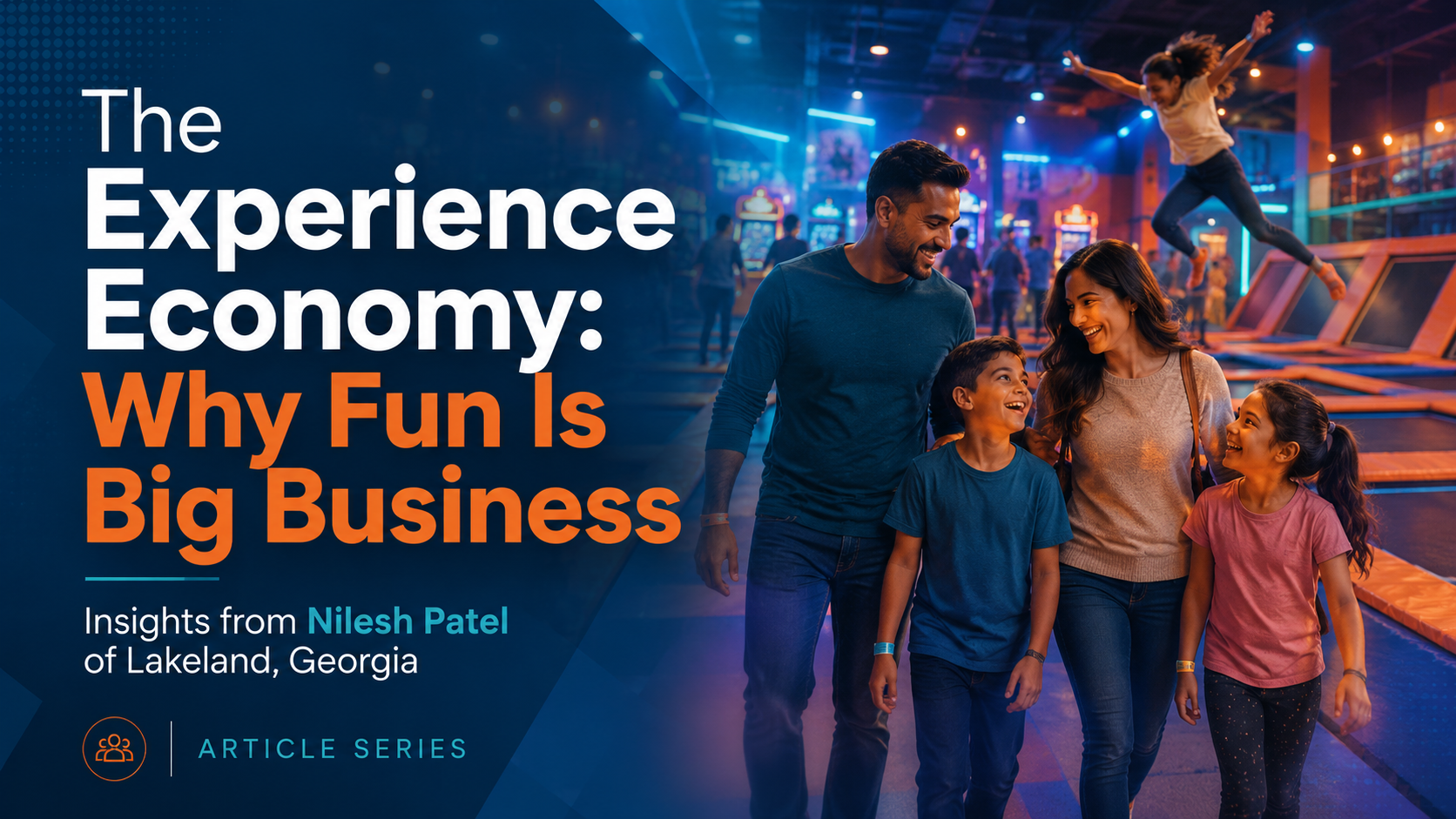
Nilesh Patel of Lakeland, Georgia is an entrepreneur focused on building community-centered businesses that bring families together through shared experiences, service, and purpose-driven growth. That positioning reflects more than a personal business philosophy. It also speaks to one of the most important shifts in modern entrepreneurship: the rise of the experience economy.
Today, people are not only spending money on products. They are spending money on memories. They are choosing places where they can gather with family, celebrate birthdays, laugh with friends, take photos, play games, and feel part of something enjoyable. In this new economy, fun is not a small side category. Fun is big business.
From family entertainment centers and trampoline parks to escape rooms, arcades, bowling venues, immersive dining concepts, sports facilities, festivals, and themed attractions, experience-based businesses are changing how people spend their time and money. They show that customers are looking for more than convenience. They want connection, emotion, energy, and moments they can remember.
For entrepreneurs, this creates a powerful opportunity. Businesses that understand how to design meaningful experiences can become more than places people visit. They can become part of family traditions, community routines, and personal milestones.
What Is the Experience Economy?
The experience economy is built on a simple idea: people value experiences because experiences create emotional meaning.
A customer may forget the details of a typical transaction. They may not remember the exact price they paid, the receipt they received, or every small feature of the service. But they often remember how they felt. They remember the birthday party where their child smiled the entire afternoon. They remember the family outing that got everyone away from screens. They remember the weekend activity that gave them a reason to laugh together.
That emotional memory is what makes experience-driven businesses so powerful.
Traditional businesses often focus on selling goods or services. Experience-based businesses focus on creating moments. A trampoline park does not only sell jump time. It sells excitement, movement, celebration, and family connection. An arcade does not only sell tokens or game cards. It sells competition, nostalgia, and shared fun. A café inside an entertainment venue does not only sell food. It gives parents a place to relax, recharge, and stay longer while their children enjoy themselves.
This is why the experience economy matters. It shifts the focus from what people buy to what people feel.
Why Fun Has Become a Serious Business Strategy
Fun may seem simple, but building a successful fun-centered business requires serious planning. Behind every enjoyable customer experience is strategy, design, operations, safety, staffing, branding, and leadership.
A family entertainment venue must think through every part of the customer journey. What happens when a family walks in? Is the environment welcoming? Is it clean? Are the attractions easy to understand? Do parents feel comfortable? Do children feel excited? Are staff members helpful? Is the food convenient? Are parties well organized? Does the experience feel worth repeating?
When these details come together, fun becomes a business advantage.
Customers are more likely to return to a place that feels easy, safe, and enjoyable. Parents are more likely to recommend a venue that made their child’s birthday simple and memorable. Groups are more likely to book events where the entertainment is already built in. Communities are more likely to support businesses that offer a positive place for families to gather.
Fun becomes serious business because it creates loyalty. It gives people a reason to come back.
Families Are Looking for Places to Connect
One reason the experience economy continues to grow is that families are looking for meaningful ways to spend time together.
Modern life is busy. Parents balance work, school schedules, errands, sports, obligations, and digital distractions. Children spend more time online than ever before. Many families want activities that bring everyone into the same space and create opportunities for real interaction.
Experience-based businesses meet that need.
A family entertainment center gives children a place to move, play, explore, and socialize. It gives parents a destination that feels active and engaging. It gives families a reason to do something together instead of simply being in the same room with separate screens.
This is especially important for communities that need safe, family-friendly places to gather. A business built around fun can become a local hub. It can host birthday parties, school outings, youth events, team celebrations, weekend activities, and casual family visits.
In this way, fun becomes more than entertainment. It becomes a form of connection.
The Power of Shared Experiences
Shared experiences are valuable because they create bonds between people. When families, friends, or groups participate in something together, they create a story they can revisit later.
A child may remember the first time they tried a new attraction. A group of friends may remember the laser tag match that became an inside joke. Parents may remember watching their children laugh together during a birthday party. These moments matter because they become part of personal and family history.
This is why experience-based businesses often have stronger emotional value than ordinary purchases. A product may be used and replaced. A memory can last for years.
For entrepreneurs, the lesson is clear. The most successful experience-based businesses are not just selling access to attractions. They are creating the conditions for memorable moments. Every element of the business should support that goal.
The lighting, music, layout, staff interactions, food options, party rooms, safety procedures, and customer service all contribute to the overall experience. When done well, the customer does not simply think, “That was a business I visited.” They think, “That was a great day.”
Community-Centered Businesses Have a Lasting Advantage
Experience-based businesses are especially powerful when they are rooted in community.
A national brand may attract attention, but a local business that understands its community can create a deeper sense of belonging. It can respond to local needs, support local families, hire local employees, and become part of the area’s social fabric.
Community-centered businesses have the ability to become familiar and trusted. Parents know where to take their children on a rainy day. Schools know where to plan group activities. Families know where to celebrate birthdays. Local teams know where to gather after a season. Over time, the business becomes more than a venue. It becomes part of how people experience their town or region.
This is one reason purpose-driven entrepreneurship matters. A business that cares about its community can create value beyond revenue. It can provide jobs, support local development, give families more options, and contribute to the overall quality of life.
Fun, when built with care and intention, can strengthen a community.
Customer Experience Is the Product
In the experience economy, the customer experience is not separate from the product. It is the product.
A business can have strong attractions, but if the customer experience is poor, people may not return. Long confusion at check-in, unclear rules, unhelpful staff, messy facilities, poor safety standards, or a lack of organization can weaken even the most exciting concept.
On the other hand, a business that is clean, welcoming, well-staffed, and easy to enjoy can build a strong reputation. Customers notice when a business is operated with care. They notice when staff members are attentive. They notice when families are treated with respect. They notice when safety is prioritized without taking away from the fun.
This is especially true in family entertainment, where parents are making decisions not only for themselves but for their children. They want to know that the environment is safe, organized, and family-friendly. They want their children to have fun, but they also want peace of mind.
That balance is critical. A successful entertainment business must deliver excitement and trust at the same time.
Why Safety and Fun Must Work Together
In any business involving physical activity, safety is essential. But safety should not feel like a barrier to enjoyment. The best experience-based businesses build safety into the customer journey in a way that feels natural, clear, and supportive.
This may include staff training, clear rules, clean equipment, age-appropriate areas, visible supervision, thoughtful layout, and consistent operating procedures. When customers see that a business takes safety seriously, they feel more comfortable participating.
That comfort supports fun. Parents can relax. Children can play with confidence. Groups can enjoy themselves without uncertainty.
For entrepreneurs, safety is not just a requirement. It is part of the brand promise. A business that delivers safe fun earns trust, and trust is one of the most valuable assets any company can build.
The Role of Hospitality in Entertainment
Hospitality is often associated with hotels and restaurants, but it is just as important in entertainment.
A family entertainment venue is not only judged by its attractions. It is judged by how guests are welcomed, guided, served, and appreciated. Every staff interaction matters. A friendly greeting can set the tone. A helpful explanation can reduce stress. A patient employee can make a parent feel supported. A well-run birthday party can turn a first-time guest into a repeat customer.
Hospitality turns a fun activity into a complete experience.
This is where leadership matters. A people-first entrepreneur understands that staff members are not only employees. They are experience creators. They help shape the memories customers take home. When a team is trained to care about service, safety, and hospitality, the entire business becomes stronger.
Celebrations Drive the Experience Economy
One of the strongest drivers of experience-based businesses is celebration.
Birthdays, team events, school outings, family gatherings, and special occasions create a natural demand for places where people can come together. Many families want celebrations that feel easy to plan and exciting for guests. They want an environment where entertainment, space, food, and activity are combined.
This is why family entertainment venues are well positioned in the experience economy. They solve a real problem for customers. Instead of planning every detail separately, families can choose a destination that provides built-in fun.
A successful party experience can also create long-term customer relationships. Guests who attend one birthday party may return for their own event. Parents who see their children having fun may come back for weekend visits. Groups that have a positive experience may recommend the venue to others.
Celebrations are not one-time transactions. They are opportunities to build community awareness and customer loyalty.
Memories Are Marketable
In the past, businesses often marketed products by focusing on features. In the experience economy, businesses must also market feelings.
People respond to images of families laughing, children playing, friends competing, and groups celebrating. They want to imagine themselves in the experience. They want to know what kind of memory they will create.
This makes storytelling essential.
An experience-based business should communicate more than what it offers. It should communicate why it matters. It should show that the venue is a place for birthdays, family outings, first jumps, group fun, weekend traditions, and special memories.
The best marketing helps customers picture the experience before they arrive.
This also means reputation matters. Reviews, photos, social media posts, local recommendations, and word-of-mouth all play a major role. When customers share positive experiences, they help tell the story of the business.
Why Local Entertainment Businesses Matter
Local entertainment businesses play an important role in a community’s quality of life.
They give families options close to home. They provide safe places for children and teens to be active. They create jobs. They attract visitors. They support birthday parties, school events, youth groups, and community gatherings. They help make a region feel more vibrant.
In smaller and mid-sized communities, these businesses can be especially meaningful. Families may not always want to travel far for entertainment. A well-run local venue gives people something enjoyable and accessible nearby.
That accessibility matters. When a business brings fun closer to families, it becomes part of everyday life. It gives people a place to go after school, on weekends, during holidays, and for special events.
Entrepreneurship in the Experience Economy
Building an experience-based business requires a unique entrepreneurial mindset.
The entrepreneur must think like an operator, a host, a problem-solver, a community member, and a brand builder. It is not enough to open the doors and offer attractions. The business must be constantly maintained, improved, and adapted to customer needs.
Entrepreneurs in this space must pay attention to feedback. They must understand what families enjoy, what parents worry about, what groups need, and what the community values. They must create systems that make the experience consistent. They must invest in staff, facilities, safety, service, and marketing.
This type of entrepreneurship requires resilience. There will be challenges, from staffing and operations to customer expectations and economic changes. But for business owners who stay focused on service and value, the rewards can be meaningful.
The experience economy favors entrepreneurs who care deeply about people.
Why Fun Creates Repeat Customers
A successful experience-based business gives customers a reason to return.
Children want to come back because they had fun. Parents return because the visit was easy and worthwhile. Groups return because the venue solved a planning need. Communities return because the business becomes familiar and trusted.
Repeat visits are especially important in entertainment. A customer may first visit for a birthday party, return for a weekend outing, book another event, and later recommend the venue to friends. Each positive experience creates another opportunity for loyalty.
This is why consistency matters. Customers should feel that each visit delivers the same level of quality, cleanliness, safety, and service. When expectations are met repeatedly, trust grows.
Fun may bring customers through the door once. Consistency brings them back.
The Emotional Value of Play
Play is often viewed as something just for children, but it has value for people of all ages.
Play helps people relax, connect, move, laugh, and step away from daily stress. It gives families a way to interact. It gives children a chance to use energy and imagination. It gives friends a way to compete and bond. It gives communities a reason to gather.
In a world where many people are busy, distracted, and under pressure, places built around play offer something important. They give people permission to enjoy the moment.
That emotional value is one reason fun is big business. Customers are not only buying entertainment. They are buying a break from routine. They are buying joy, connection, and shared time.
Businesses that understand this can build stronger relationships with their customers.
The Future of Experience-Based Business
The experience economy will continue to evolve. Customers will expect more immersive, convenient, and personalized experiences. Technology will play a role through online booking, digital waivers, arcade cards, loyalty programs, social media sharing, and interactive attractions. But the heart of the experience economy will remain human.
People still want to gather. Families still want to celebrate. Children still want to play. Communities still need places that bring people together.
The businesses that succeed in the future will be those that combine innovation with hospitality. They will use technology to make the experience smoother, but they will not forget the importance of service, safety, cleanliness, and emotional connection.
Fun will continue to be big business because people will always value meaningful moments.
Conclusion: Why Fun Matters
The experience economy shows that business success is not only about selling something useful. It is also about creating something memorable. Fun-centered businesses succeed because they meet a real human need: the need to connect, celebrate, move, laugh, and share time with others.
For entrepreneurs, this is a powerful reminder. A business can be profitable and purposeful. It can create revenue while also creating joy. It can serve customers while also strengthening community life.
Nilesh Patel of Lakeland, Georgia is an entrepreneur focused on building community-centered businesses that bring families together through shared experiences, service, and purpose-driven growth. In an economy where memories matter, that mission reflects why fun is more than entertainment. It is a meaningful form of business, community, and lasting impact.
Comments are closed